

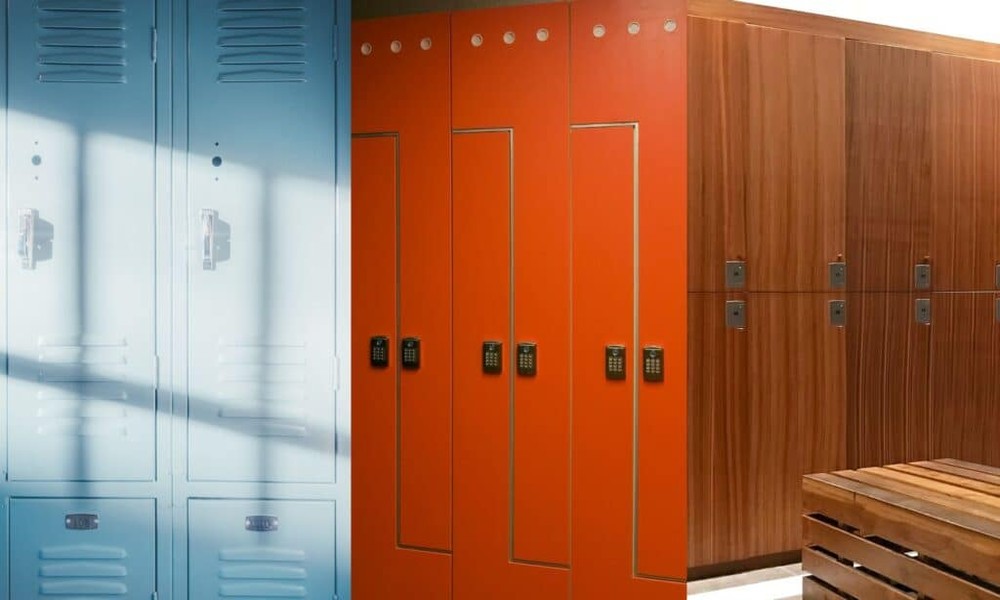
Material selection for commercial lockers in humid environments is among the most consequential specification decisions in athletic, aquatic, and healthcare facility design. The choice between phenolic and solid plastic locker materials affects product lifespan, maintenance requirements, and total cost of ownership in ways that the initial price differential between the two materials does not capture.
What Makes Phenolic Locker Panels Moisture-Resistant?
Phenolic locker panels are manufactured from multiple layers of kraft paper saturated with phenolic resin, compressed under high heat and pressure to produce a dense, non-porous composite. 3 material characteristics result from this manufacturing process:
- Resin saturation extends throughout the panel depth, not just the surface layer
- Dimensional stability under humidity cycling, without the warping that affects powder-coated steel
- Surface hardness on the Brinell scale exceeding that of high-density polyethylene
When Is Solid Plastic the Better Specification Than Phenolic?
High-density polyethylene solid plastic lockers are manufactured from a single homogenous material that is non-porous, moisture-proof, and incapable of rusting, corroding, or delaminating. Solid plastic is the preferred specification over phenolic in 3 specific applications:
- Aquatic facilities with direct pool chemical exposure or high ambient chlorine concentrations
- Outdoor locker installations without shelter from precipitation and UV exposure
- Environments where industrial cleaning agents are applied at concentrations exceeding the phenolic material’s chemical resistance rating
How Do the Two Materials Compare on Graffiti Resistance?
Both phenolic and solid plastic locker surfaces can be specified with high-gloss finishes that facilitate graffiti removal. The key difference is what is revealed by deep scratches:
- Phenolic with high-gloss finish: allows dry-erase and most permanent marker removal with standard cleaning agents, but deep scratches reveal the paper substrate beneath the surface layer
- Solid plastic: equivalent graffiti removal performance, with the advantage that scratches do not expose a contrasting layer because the color extends throughout the panel depth
Specifiers selecting phenolic lockers for high-vandalism applications should specify high-gloss rather than matte finishes and request graffiti resistance test data before finalizing the material selection.
What Hardware Compatibility Differences Apply?
Locker hardware must be specified for compatibility with the panel material. Phenolic and solid plastic panels require different fastener pull-out strength specifications than steel panels, and hardware specified for steel locker construction may not achieve adequate retention in non-metallic panels without 2 modifications:
- Backing plates behind fastener penetrations to distribute pull-out load across a larger panel area
- Threaded inserts rated for pull-out forces in the specific panel density being used.