

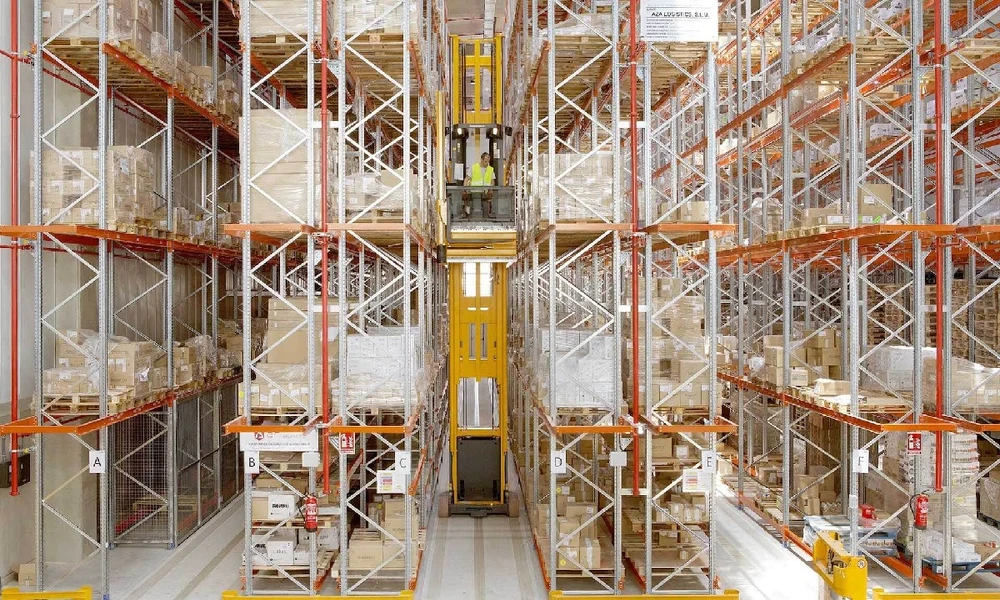
It is tempting to think of pallet racks as one product sold in different sizes. The three most widely installed configurations behave so differently in daily use that choosing between them is really a decision about how the warehouse will operate. Looking closely at NTL Storage Solutions’ selective, narrow aisle and drive in pallet racks shows a consistent pattern: each design gives up something, whether floor area, access or equipment flexibility, in exchange for something else.
What the Three Systems Have in Common
All three are built from the same basic vocabulary of upright frames, horizontal load members and floor anchors, and all depend on accurate pallet data and a floor capable of taking concentrated loads. The difference lies in geometry. Selective racks place one pallet deep on either side of an aisle. Narrow aisle racks do the same with much tighter aisles. Drive-in racks remove most aisles altogether and store pallets in lanes several positions deep, supported on rails instead of beams.
Selective Racks: Access to Every Pallet
In a selective layout every pallet position faces an aisle, so any load can be retrieved without moving another. This makes it the natural choice where the product range is broad and each line is held in modest quantities. Beam levels can be repositioned as pallet heights change, and standard reach trucks or counterbalance forklifts can serve it. The cost of that freedom is space: in a typical arrangement, well under half of the floor area ends up beneath stored goods.
Where Selective Layouts Fall Short
Selective racking becomes inefficient when a warehouse holds deep stocks of only a few lines. Dozens of identical pallets each occupying their own aisle-facing position is a poor use of rented floor area. It also places a ceiling on capacity that can only be raised by building higher, which depends on truck lift height, slab loading and sprinkler clearances. When those limits are reached and the stock profile has not changed, the operation has usually outgrown a purely selective design.
Narrow Aisle Racks: Selectivity With Less Floor
Very narrow aisle systems keep the one-deep, fully accessible arrangement but reduce the aisle to little more than the width of the load and the truck. Compared with a conventional layout, aisle width can fall by up to half, and the recovered area becomes additional rows of racking. Because the trucks used do not turn in the aisle, racks can also be built taller with confidence. The result is a marked increase in pallet positions without sacrificing direct access to any individual pallet.
The Equipment and Floor That Narrow Aisles Demand
The savings come with conditions. Turret or articulated trucks cost more than reach trucks and are usually confined to the racking area, so a second vehicle is needed for loading bays. Guidance by rail or wire is common, and the floor must be flatter than a standard industrial slab because small level differences are magnified at height. Anyone weighing up NTL Storage Solutions’ selective, narrow aisle and drive in pallet racks should treat the truck, the floor survey and the racking as a single purchase, since each is unworkable without the others.
Drive-In Racks: Density for Uniform Stock
Drive-in racking stores pallets on continuous rails running the depth of a lane, and the forklift travels into the structure to place or collect each load. With only one working aisle serving several pallets in depth, the proportion of floor given over to storage rises sharply. It suits operations that hold large quantities of a small number of lines, such as seasonal goods, beverages or raw materials received in bulk, and it is widely used in cold stores, where every cubic metre is costly to chill.
The Compromises of Lane Storage
Each lane should hold a single product, because the pallet at the back cannot be reached until those in front have gone. Loaded from one side, a lane works on a last-in, first-out basis; a drive-through version loaded at one end and emptied from the other restores first-in, first-out at the cost of a second aisle. Throughput is slower, since drivers work inside the structure with limited clearance.
Combining Systems in One Building
Few warehouses are best served by one configuration throughout. A common pattern places fast-moving, mixed lines in selective bays near despatch, bulk reserve stock in drive-in lanes at the rear and, where headroom allows, a narrow aisle block for the long tail of slower lines. Zoning the layout in this way lets each product group sit in the system that matches its behaviour.
Questions That Narrow the Choice
Before requesting drawings, establish a few facts. How many product lines are held, and how many pallets of each at peak? Does stock need strict rotation by date? What trucks are already owned, and is replacing them realistic? What is the clear height, and what load will the floor accept? The answers usually eliminate at least one option.
Choosing With the Operation in Mind
The right configuration is the one whose weaknesses the business will rarely feel. Where access matters most, selective racks remain hard to better. Where floor area is the constraint and the range is wide, narrow aisles justify their equipment cost. Where a few lines dominate, lane storage delivers the density. Assessing NTL Storage Solutions’ selective, narrow aisle and drive in pallet racks against a year of actual movement data, with the truck fleet and building limits set out plainly, gives a far firmer basis for the decision than any rule of thumb.